
|
|
The Fear Of Witchcraft
'Two personages ensconced in a fortified castle are pointinig out the witch from the top of the towers to a third personage who is setting two dogs upon a witch and bolting into the castle by the open door.'
What is a Spell anyway?
1. A word or words believed to have magic powers
2. Any strong influence
The six research committees to study
1. Thought transference, later renamed Telepathy by Myers
2. Mesmerism, Hypnotism, Clairvoyance and related phenomena
3. German scientist Baron Karl von Reichenach's research into "sensitives"
4. Apparitions of all types, and hauntings
5. Physical phenomena associated with spiritualistic mediums
6. The collection of of data on the history of the above subjects.
The spr then embarked on a massive amount of research. The Siagwick Group, with its high level of contacts, attracted the interest of numerous emminent people. This included researcher Wlliam Crookes, Oliver Lodge, author Arthur Conan Doyle, philosopher and psychologist William James, and later psychiatris Sigmund Freud, Carl G. Jung, and others.
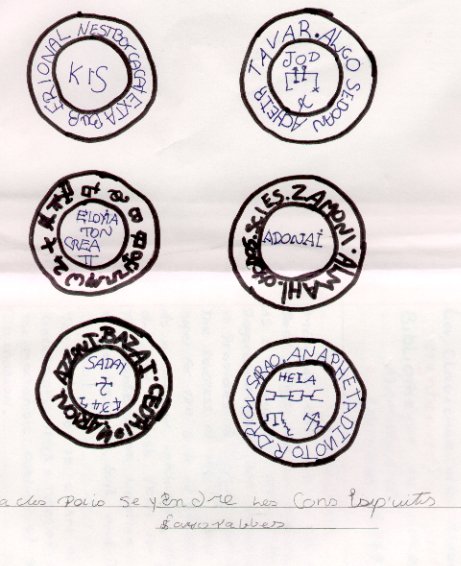
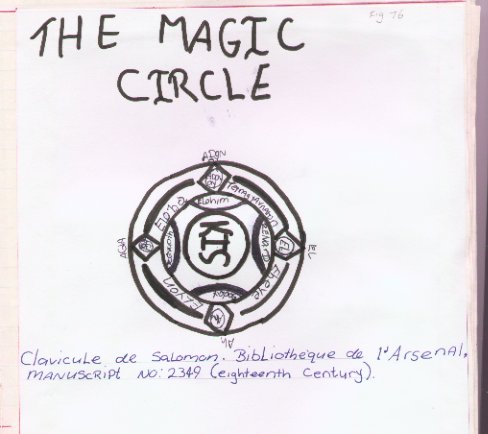
The Six Pentacles to Influence Good Spirits Favourably
La Clavicule de Solomon (eighteenth century) Bibliotheque de l'Arsenal
Manuscript
# 2349
Witchcraft
Magical art in the west is both a system of magic and an organized religion.
As a magical art, witchcraft is usuallly regarded with fear and uncertainty.
In reality, it actually provides a social function by enabling the redress
of wrongs and grievances, as well as hope for the end of ilnesses and problems.
 As
a religion, witchcraft is often called "wicca" (an old english term for
witch) in order to counter the negative stereotypes of witches as ugly,
evil devil worshippers.
As
a religion, witchcraft is often called "wicca" (an old english term for
witch) in order to counter the negative stereotypes of witches as ugly,
evil devil worshippers.
Witchcrsft as an art of magic exists universally. It is a type of sorcery
involving the mechanistic casting of spells since divination.
Persecution Of Witches
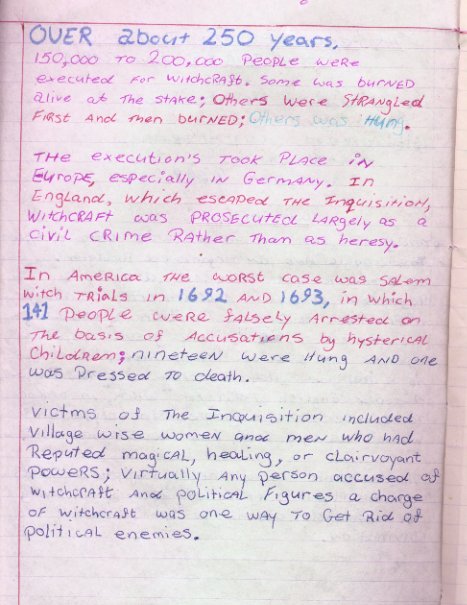
Over about two hundred and fifty years one hundred and fity to two hundred
thousand people were executed for witchcraft. Some were burned alive at
the stake, others were strangled first and then drowned. Still others were
hung, as in Salem in America.
Many of the executions took place in Europe, especially in Germany.
In England, which escaped the inquisition, witchcraft was prosecuted largely
as civil crime rather than heresy.
In America the worst single case was in Salem at the witch trials of
1692 and 1693. One hundred and forty one people were falsely arrested on
the basis of accusations by hysterical children. Nineteen were hung and
one was pressed to death by great rocks. This was dramatized in Arthur
Miller's play 'The Crucible.'
Victims of the inquisition included village wise women and men who
had reputed magical, healing, or clairvoyant powers, and virtually any
person accused of witchcraft. Political figures would invent a charge of
witchcraft as a way to get rid of their political enemies. Others did same
to exact revenge upon someone.
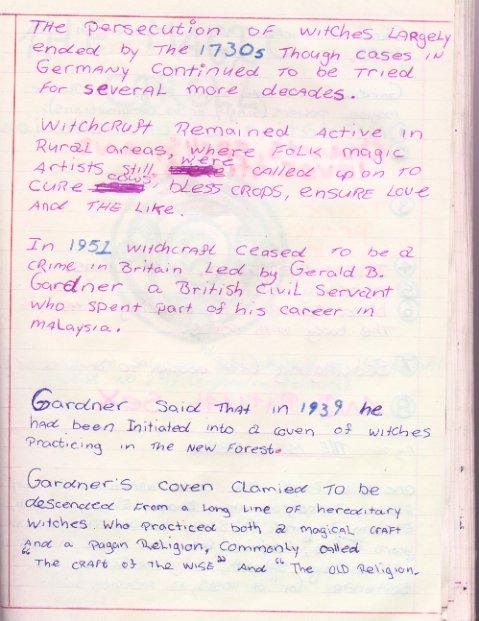
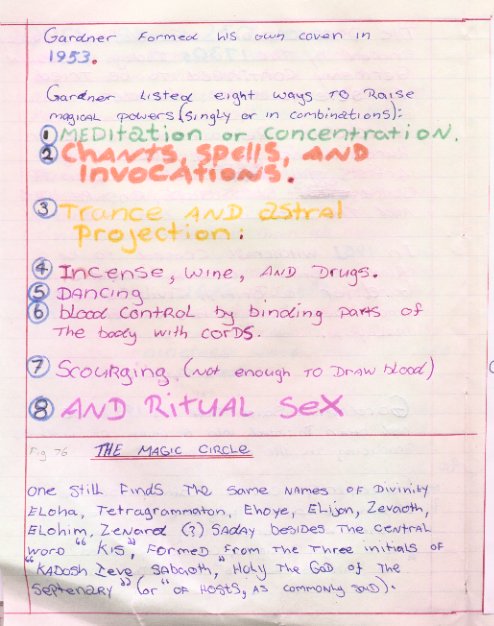
The original notes:
Page 1 Page 2 Page 3 Page 4 Page 5 Page 6 Page 7 Page 8 Page 9 Page 10
 Previous
Page Previous
Page |
Next Page
 |
Back to Angels's Paradise


